The Times and The Daily Mail - Kazakh eagle hunters
My photos of the Golden Eagle Festival in Ölgii (Bayan-Ölgii), in the Altai mountains in the far west of Mongolia, attracted a lot of interest. They appeared first in the British press, in The Times and The Daily Mail Online, and afterwards also in smaller media in Switzerland and Germany, together with my article about the Kazakh eagle hunters
The Daily Mail Online (United Kingdom)
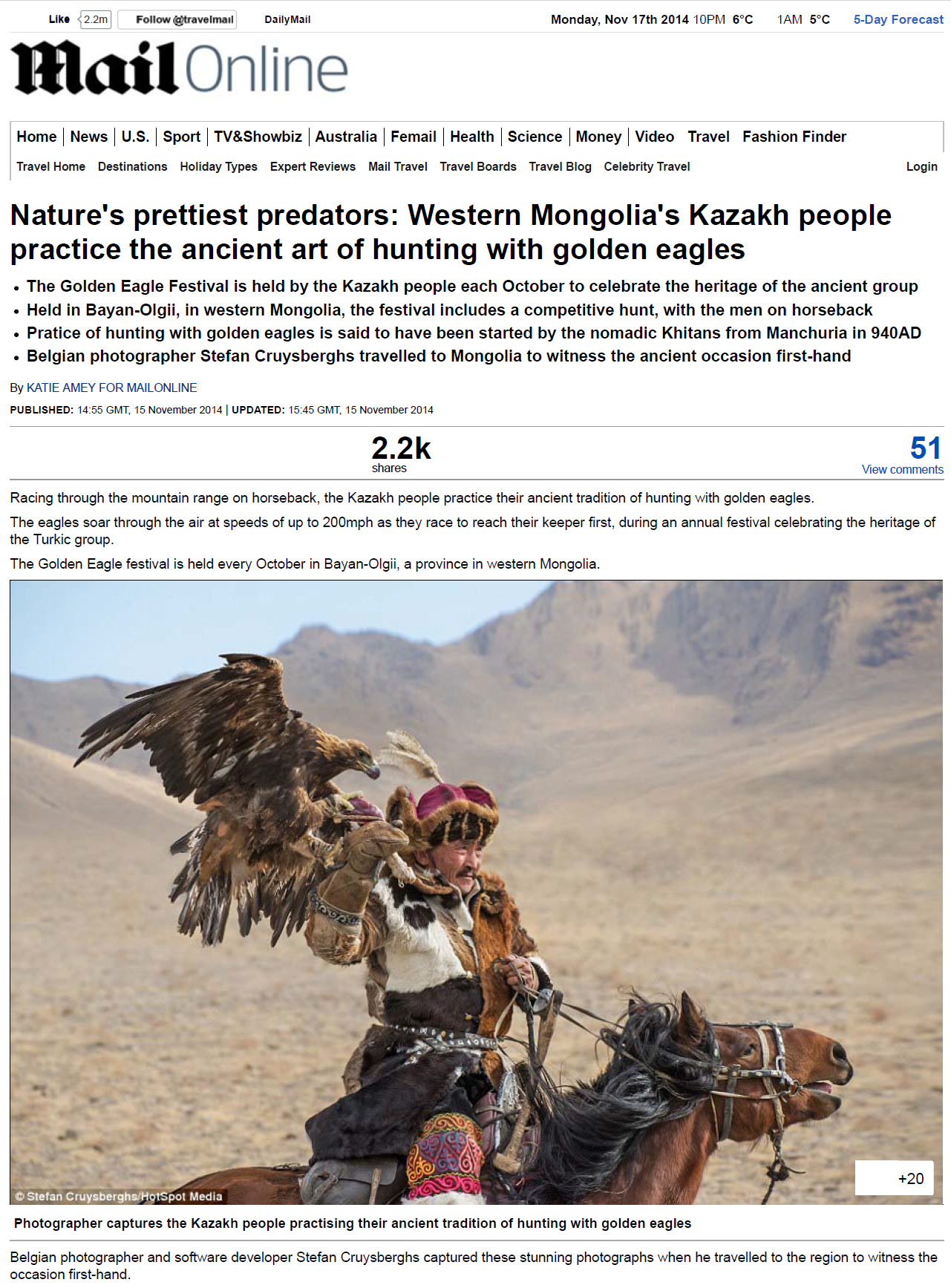
Nature's prettiest predators: Western Mongolia's Kazakh people practice the ancient art of hunting with golden eagles
- The Golden Eagle Festival is held by the Kazakh people each October to celebrate the heritage of the ancient group
- Held in Bayan-Olgii, in western Mongolia, the festival includes a competitive hunt, with the men on horseback
- Pratice of hunting with golden eagles is said to have been started by the nomadic Khitans from Manchuria in 940AD
- Belgian photographer Stefan Cruysberghs travelled to Mongolia to witness the ancient occasion first-hand
Daily Mail Online, Published: 14:55 GMT, 15 November 2014
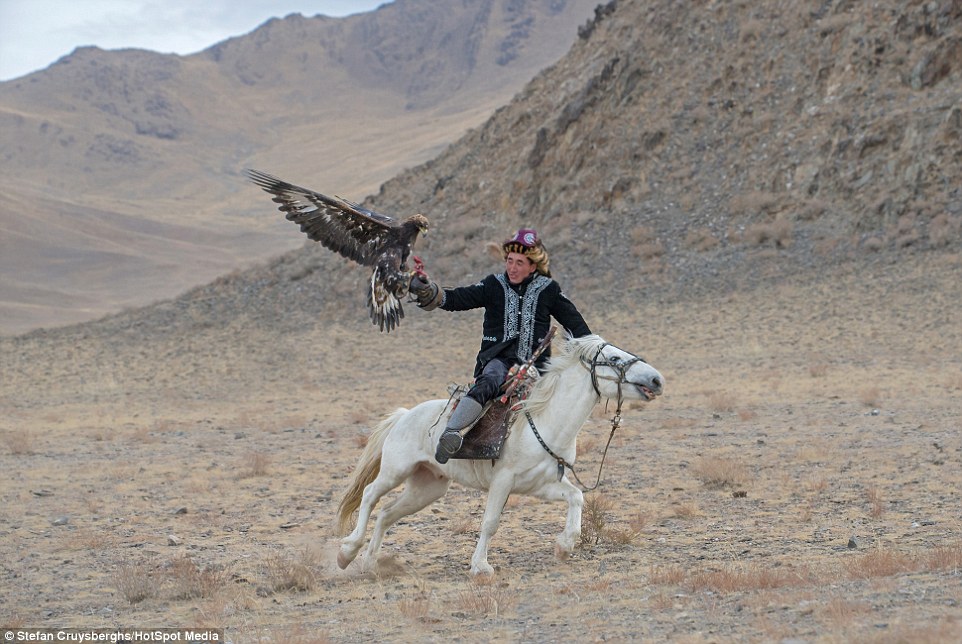
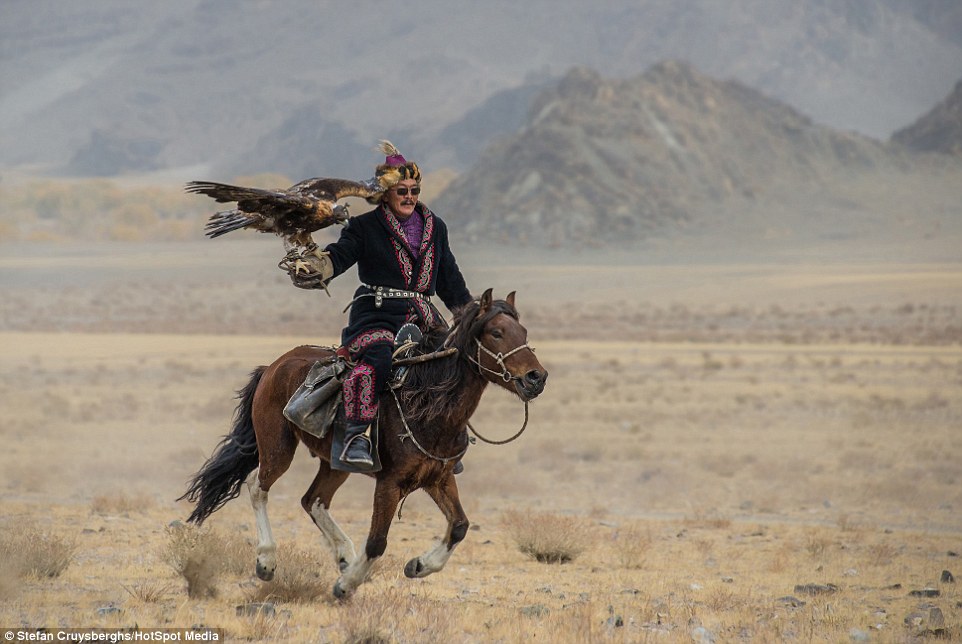
- Racing through the mountain range on horseback, the Kazakh people practice their ancient tradition of hunting with golden eagles.
- The eagles soar through the air at speeds of up to 200mph as they race to reach their keeper first, during an annual festival celebrating the heritage of the Turkic group.
- The Golden Eagle festival is held every October in Bayan-Olgii, a province in western Mongolia.
- Belgian photographer and software developer Stefan Cruysberghs captured these stunning photographs when he travelled to the region to witness the occasion first-hand.
- The 38-year-old, of Lommel, Belgium, said: 'The world is evolving fast, but these Kazakh people still practice the ancient art of training and hunting with golden eagles, and they do it with a lot of passion.
- 'The competitions during the Golden Eagle Festival show the long-term and trusting relationship between the eagle and the hunter.
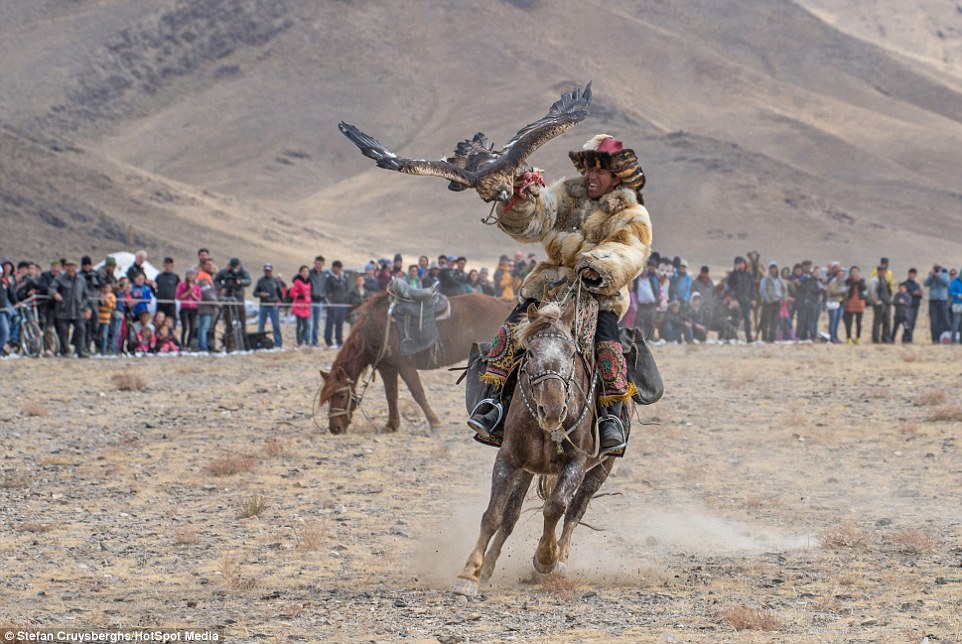
- 'During the first competition each golden eagle is released from the top of a mountain and the birds race to catch some meat which is held by an eagle hunter on his galloping horse.
- 'The eagle and hunter are communicating with each other via cries, and whichever hunters' eagle reaches the meat the fastest, wins the game.'
- The Kazakhs of the Altai mountain range in western Mongolia are the only people that hunt with golden eagles, and today there are around 400 practising falconers.
- The tradition of hunting with golden eagles is said to have been started by the nomadic Khitans from Manchuria in northern China around 940AD.
- Other activities held during the Golden Eagle festival include horse racing, archery and Bushkashi, which is a goatskin tug of war on horseback
- The festival also sees awards handed out for Best Turned Out Eagle And Owner, Best Eagle At Hunting Prey and Best Eagle At Locating Its Owner From A Distance.
- Discussing the bond between eagles and their human counterparts, photographer Stefan says: 'Young female golden eagles are caught in the wild and aren't given any food for several days.
- 'They will then start to accept food from humans and when trust between hunter and bird is gained, the hunter will start training the eagle.
- 'They become a part of the family and a long-term relationship is created.
- 'The relationship between the eagle and hunter only lasts for six to eight years and they take part in the competitions together year after year.
- 'After that, the female eagle is released back into the wild so she can breed.'
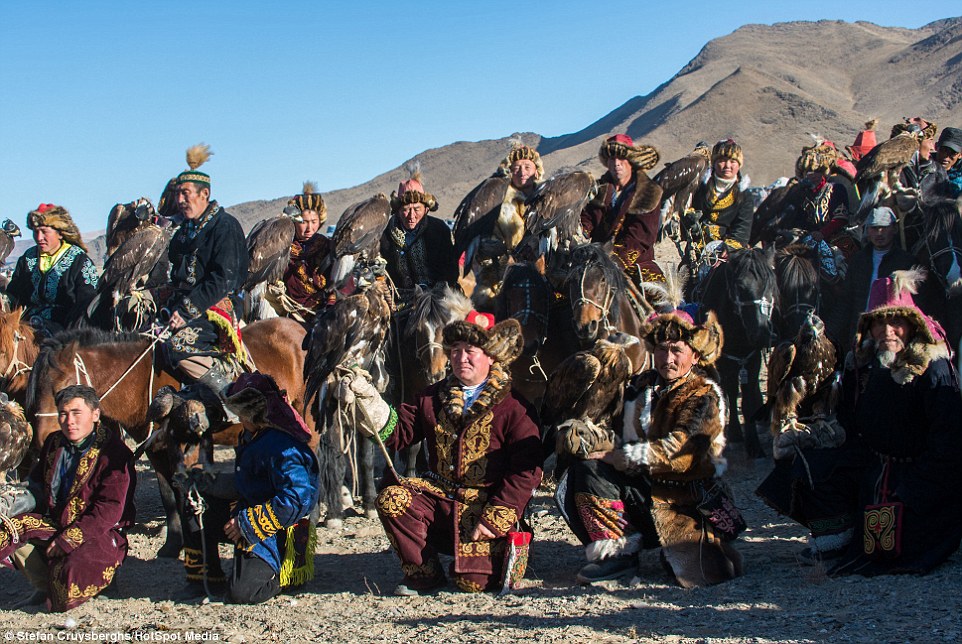
- Every October up to 70 eagle hunters and a host of tourists gather to celebrate Kazakh customs in the shadow of the Altai Mountains during the annual two day Golden Eagle Festival.
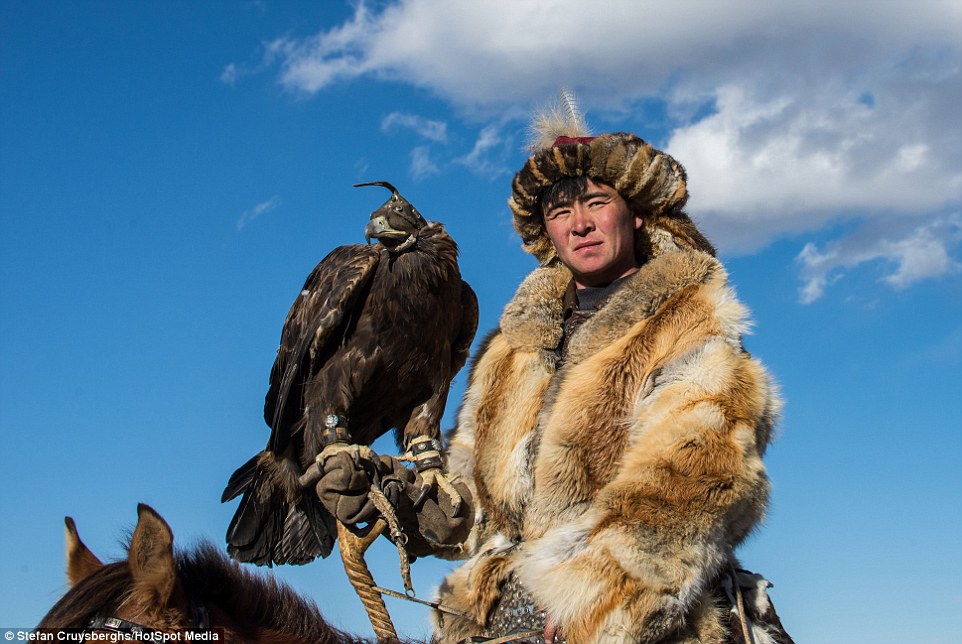
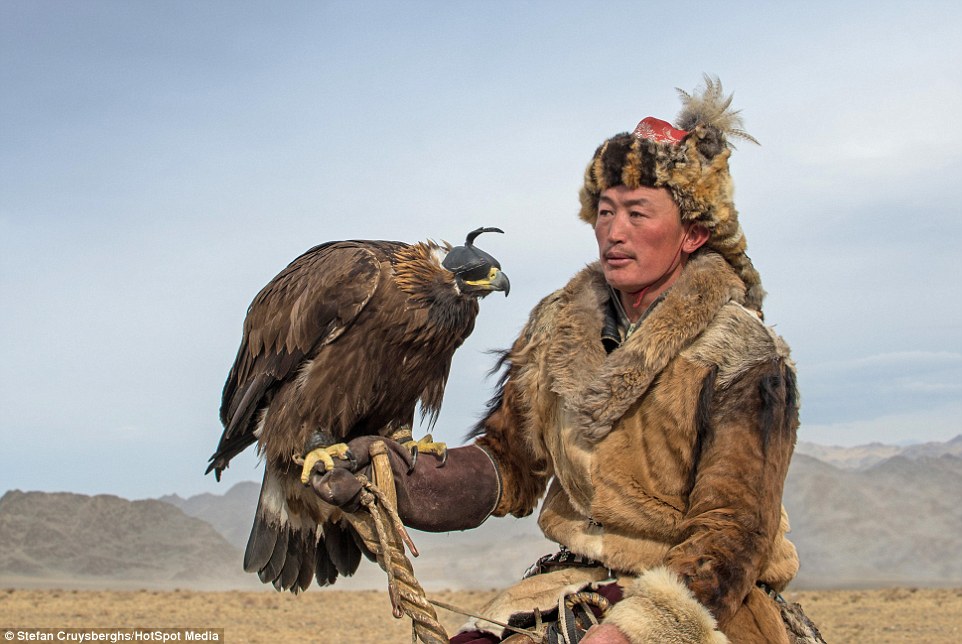
- The hunters wear traditional costumes, complete with fur coats made of marmot, fox or wolf skins which have been caught by their eagles.
- The more extravagant the coat the more respected the hunter is.
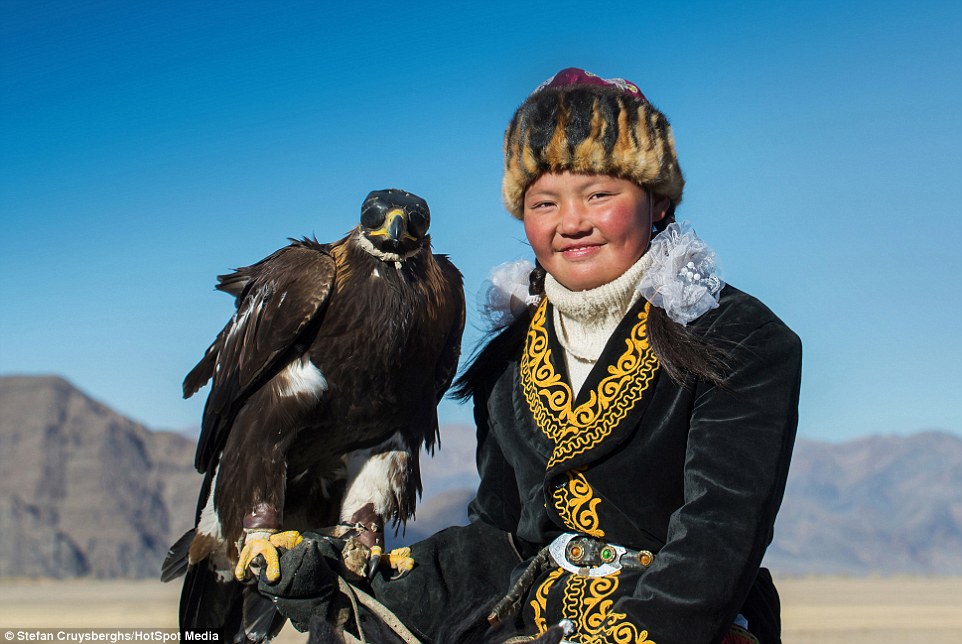
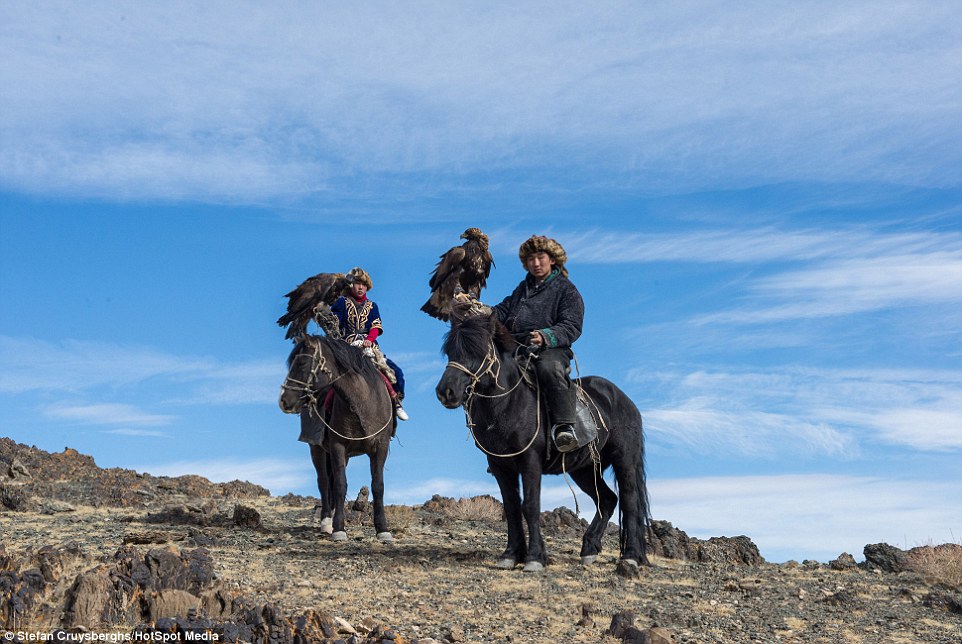
- Stefan says: 'The Kazakh eagle hunting tradition was always male-dominated, but nowadays some fathers teach their young daughters the art and skills of the ancient eagle hunter tradition.
- 'This year there were two young girls at the Golden Eagle Festival, it is great to see that young people still embrace their cultural heritage.'
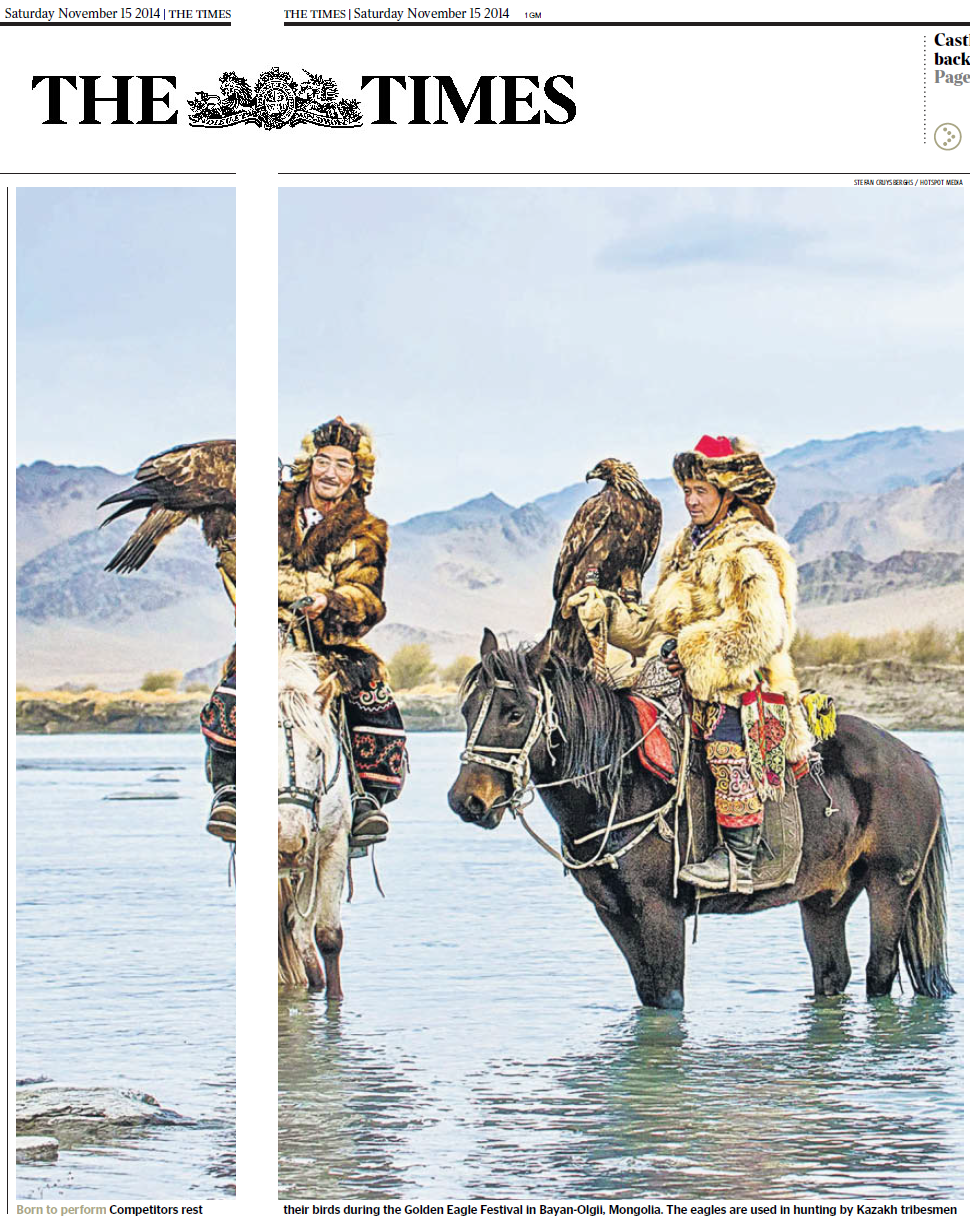
The Times (United Kingdom)
The Times, Saturday 15 November 2014: a photo of the Kazakh eagle hunters in the river, captioned "their birds during the Golden Eagle Festival in Bayan-Olgii, Mongolia".
Bluewin.ch (Switzerland, French)

Le festival de l'aigle - Les Kazakhs et leurs aigles royaux
- Majestueux. Voici le mot qui vient à l'esprit lorsque l'aigle royal s'envole vers l'horizon. Cet oiseau semble être l'incarnation même de la liberté. Mais après un son à peine perceptible, le voilà qui fait demi-tour vers ses maîtres. Au Kazakhstan, le roi du ciel est vénéré et respecté. Le dresser est un gage de force et puissance.
- C'est au cours du festival de l'aigle (Golden Eagle Festival) qui a lieu tous les ans au mois d'octobre dans l'aïmag de Bayan-Ölgiy en Mongolie, que les dresseurs d'aigles se rencontrent.
- Depuis des millénaires, ces rapaces aident les hommes de la région à chasser.
- Le belge Stefan Cruysberghs (38 ans) a été témoin de ce travail d'équipe spectaculaire entre l'homme et l'animal:
- «Notre monde ne jure que par l'avancée technologique toujours plus rapide. Mais au Kazakhstan, le temps semble s'être figé. Ici, on entraîne des aigles royaux depuis des générations».
- «La passion et la confiance que les propriétaires placent en leurs rapaces sont palpables. Ce sport, c'est toute leur vie».
- «Au cours d'un des tournois, les aigles sont lâchés dans la montagne pendant qu'un Kazakh galope à cheval dans la vallée avec un morceau de viande à la main. Le but du jeu consiste à ce que les aigles rattrapent le cavalier et s'emparent du morceau de viande».
- «La communication entre l'aigle et son maitre se fait à travers des cris».
- La région ne compte pas moins de 400 aigliers. Mais comment expliquer ce solide lien entre l'oiseau et l'homme?
- «Ce sont des femelles. Elles sont capturées jeunes et ne reçoivent pas de nourriture pendant quelques jours».
- «C'est de cette manière qu'elles reconnaissent l'homme comme étant leur maître et, à plus ou moins long terme, comme faisant partie d'une même famille».
- La durée maximale de captivité des animaux est de 8 ans. Ils sont ensuite relâchés. Leur instinct demeurant intact jusqu'à la fin de leur vie.
- Chaque année, près de 70 aigliers se donnent rendez-vous à l'ombre des hauts sommets de l'Altaï, pour prendre part au festival.
- Les chasseurs arborent vêtements traditionnels en peau de marmotte, de renard ou de loup: plus l'habit est impressionnant et plus le chasseur est respecté.
- «Traditionnellement, la chasse avec un aigle est un domaine réservé aux hommes. Mais cette année, deux chasseurs ont amené leurs filles afin qu'elles participent au tournoi».
- Majestic. That is the word that comes to mind when the golden eagle flies off towards the horizon. This bird seems to embody freedom itself. But after a barely audible sound it turns back to its masters. In Kazakhstan the king of the sky is revered and respected. Training one is a sign of strength and power.
- The eagle hunters meet during the Golden Eagle Festival, held every year in October in the aimag of Bayan-Olgii in Mongolia.
- For thousands of years these birds of prey have helped the people of the region to hunt.
- The Belgian Stefan Cruysberghs (38) witnessed this spectacular teamwork between man and animal:
- 'Our world is all about ever faster technological progress. But in Kazakhstan time seems to have stood still. Here golden eagles have been trained for generations.'
- 'The passion and the trust the owners place in their birds of prey are tangible. This sport is their whole life.'
- 'During one of the tournaments the eagles are released in the mountains while a Kazakh gallops through the valley on horseback with a piece of meat in his hand. The aim is for the eagles to catch up with the rider and seize the meat.'
- 'The eagle and its master communicate with each other through cries.'
- The region has no fewer than 400 eagle hunters. But how can this strong bond between bird and man be explained?
- 'They are females. They are caught young and get no food for a few days.'
- 'This is how they recognise the man as their master and, sooner or later, as part of the same family.'
- The animals stay in captivity for 8 years at most. They are then released, as their instinct remains intact until the end of their lives.
- Every year nearly 70 eagle hunters meet in the shadow of the high peaks of the Altai to take part in the festival.
- The hunters wear traditional clothing of marmot, fox or wolf fur: the more impressive the outfit, the more respected the hunter.
- 'Traditionally, hunting with an eagle is a men's affair. But this year two hunters brought their daughters along to take part in the tournament.'
Ohwow.de (Germany, German)

Golden Eagle Festival - Kasachen und ihre Steinadler
- Majestätisch fliegen sie in Richtung Horizont. Diese Steinadler scheinen der Inbegriff von Freiheit zu sein. Auf einen kaum hörbaren Ruf ihrer Herren hin jedoch fliegen sie zurück.
- In Kasachstan verehrt man den König der Lüfte. Man hat Respekt vor den Tieren. Sie zu zähmen wird als Beweis von Kraft und Stärke verstanden.
- Beim Golden Eagle Festival im mongolischen Bajan-Ölgii-Aimag treten jedes Jahr im Oktober Steinadler und ihre Besitzer gegeneinander an.
- Die Raubvögel helfen dem Menschen in der Region seit vielen tausend Jahren bei der Jagd.
- Der Belgier Stefan Cruysberghs (38) wurde Zeuge dieser spektakulären Zusammenarbeit von Tier und Mensch:
- „Unsere Welt ist von rasantem Fortschritt geprägt. In Kasachstan jedoch scheint die Zeit still zu stehen. Seit vielen Generationen trainiert man hier die Steinadler."
- „Man kann die Leidenschaft und das Vertrauen der Besitzer zu ihren Vögeln förmlich spüren. Sie leben für diesen Sport."
- „Bei einem der Wettbewerbe werden die Adler im Gebirge frei gelassen und im Tal steht ein Kasache mit einem Stück Fleisch in der Hand. Er galoppiert auf seinem Pferd davon. Die Adler müssen ihn einholen und das Fleisch fangen."
- „Die Besitzer und ihre Adler kommunizieren miteinander, indem sie Schreie von sich geben."
- An die 400 Falkner gibt es in der Region. Doch wie entsteht dieses starke Band zwischen Vogel und Mensch?
- „Es handelt sich um Weibchen. Sie werden als Jungtiere gefangen und bekommen dann einige Tage lang keine Nahrung."
- „Dadurch erkennen sie den Menschen als ihren Herren an und sehen sich über kurz oder lang als Teil einer Familie."
- Die Adlerweibchen leben nur maximal acht Jahre in Gefangenschaft. Danach werden sie in die Freiheit entlassen. Zu ungebrochen ist auf Dauer ihr Wille.
- Am Festival nehmen jedes Jahr an die 70 Falkner teil. Sie treffen sich im Schatten des Altai-Hochgebriges.
- Die Jäger tragen traditionelle Gewänder aus Murmeltier-, Fuchs und Wolfsfällen. Je imposanter das Gewand, desto respektierter ist der Jäger.
- „Obwohl die Jagd mit dem Adler traditionell eher eine Männerdomäne ist, haben in diesem Jahr auch zwei Männer ihre Töchter an dem Festival teilnehmen lassen."
- Majestically they fly towards the horizon. These golden eagles seem to be the epitome of freedom. At a barely audible call from their masters, however, they fly back.
- In Kazakhstan the king of the skies is revered. People respect the animals. Taming them is regarded as proof of strength and power.
- At the Golden Eagle Festival in the Mongolian aimag of Bayan-Olgii, golden eagles and their owners compete against each other every October.
- The birds of prey have helped the people of the region to hunt for many thousands of years.
- The Belgian Stefan Cruysberghs (38) witnessed this spectacular teamwork between animal and man:
- 'Our world is marked by rapid progress. In Kazakhstan, however, time seems to stand still. Here golden eagles have been trained for many generations.'
- 'You can literally feel the passion and the trust the owners have in their birds. They live for this sport.'
- 'In one of the competitions the eagles are released in the mountains and a Kazakh stands in the valley with a piece of meat in his hand. He gallops away on his horse. The eagles have to catch up with him and take the meat.'
- 'The owners and their eagles communicate with each other by uttering cries.'
- There are about 400 falconers in the region. But how does this strong bond between bird and man come about?
- 'They are females. They are caught as young animals and then get no food for a few days.'
- 'As a result they recognise the man as their master and, sooner or later, see themselves as part of a family.'
- The female eagles live in captivity for eight years at most. After that they are released. In the long run their will is too unbroken.
- About 70 falconers take part in the festival every year. They meet in the shadow of the Altai mountains.
- The hunters wear traditional robes of marmot, fox and wolf fur. The more imposing the robe, the more respected the hunter.
- 'Although hunting with the eagle is traditionally a male domain, this year two men also let their daughters take part in the festival.'